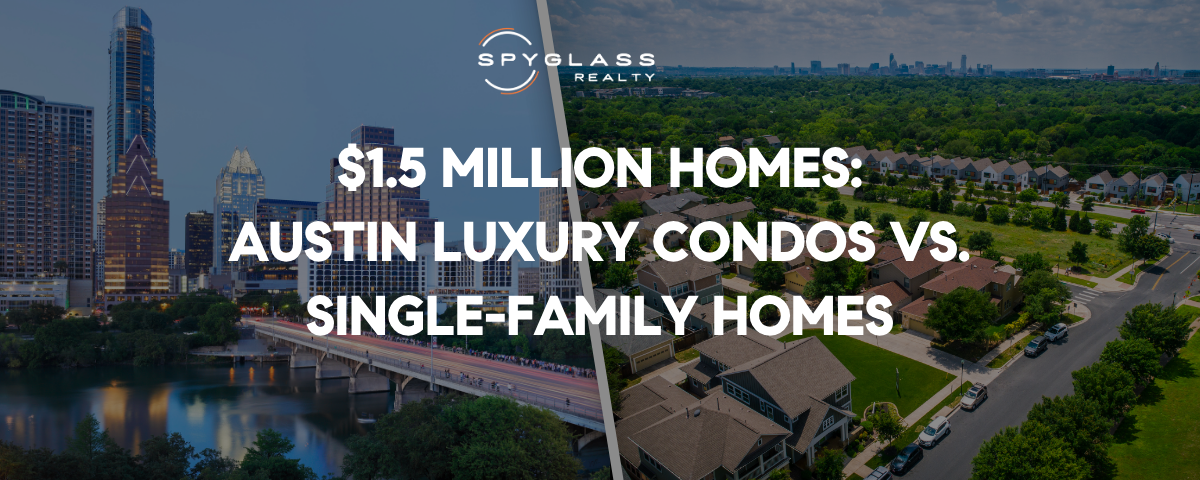
If you are weighing Austin luxury condos against a single-family home above $1.5 million, you are asking a question that goes well beyond square footage. Both property types offer genuine value in Austin's upper tier. The real question is which one fits your finances, your lifestyle, and your plans for the next five to ten years.
Maybe you picture a downtown penthouse with skyline views, a concierge, and zero lawn to manage. Or maybe you picture a Westlake estate with a pool, mature oaks, and space to spread out in a way that no high-rise can replicate. Both are reasonable pictures. They just come with very different costs, trade-offs, and long-term dynamics.
This guide walks through how the Austin luxury market actually looks above $1.5 million, what each property type truly costs when you account for everything, how they compare on long-term appreciation, and who each one tends to suit. The answer is rarely obvious, but the right framework makes it manageable.
How the Austin Luxury Market Looks Above $1.5M Right Now
Austin's upper-tier market has remained one of the more resilient segments in the metro, even as the broader market has cooled. According to Texas Realtors, the Austin metro saw approximately $4.6 billion in million-dollar-plus home sales over the most recent 12-month reporting period, representing nearly 19% of all luxury transactions across Texas. That is a meaningful base of activity for buyers and sellers operating in this segment.Single-family homes in the luxury segment
The Austin luxury real estate guide puts the average luxury home in Austin at around $1.67 million, with roughly 3,440 square feet at approximately $510 per square foot. Above $1.5 million, you are generally looking at properties in areas like Westlake, Barton Creek, Tarrytown, and the Lake Austin corridor. Inventory has improved compared to the pandemic peak years, which gives qualified buyers more negotiating room than they have had in recent cycles. Data from the Austin Board of Realtors via Unlock MLS shows that in February 2026, 48 single-family homes sold above $1.4 million within Austin city limits alone, representing nearly 9% of all transactions. The luxury segment is consistent and active, though properties in this range are spending more days on market than they did in 2021 and 2022, which means there is room to negotiate on price and terms.Luxury condos above $1.5M in Austin
True luxury condos above $1.5 million in Austin are concentrated in a handful of downtown and near-downtown buildings, including The Austonian, Four Seasons Private Residences, The Independent, and The Seaholm District towers. The downtown Austin condos guide covers how condo pricing in this range can exceed $3 million for penthouses and upper-floor units with commanding views. Larger floor plans and higher floors drive pricing significantly, and price per square foot at this level can be well above the single-family average. It is worth noting that inventory in the attached luxury segment is more building-specific. When a new luxury tower delivers units, it can temporarily soften pricing in older buildings nearby. That supply dynamic is different from the single-family market, where lot scarcity in premium neighborhoods creates more consistent demand. >> EXPLORE AUSTIN LUXURY REAL ESTATE <<What Does $1.5M Actually Buy You in Each Category?
The purchase price is the same, but what you get for it is very different. Understanding those differences clearly is one of the most useful things you can do before committing to either path.Space, location, and finishes
At $1.5 million in the single-family market, you are typically looking at 2,800 to 3,500 square feet in established Austin neighborhoods, often with a yard, a two or three-car garage, a pool in many cases, and the kind of indoor and outdoor living space that Austin's climate supports well. Neighborhoods like West Austin, Circle C, and the Lake Travis corridor offer properties in this range with Hill Country views and mature landscaping. For a look at where these homes concentrate, Austin's most expensive neighborhoods provides a useful orientation. At $1.5 million in the luxury condo market, you are typically looking at 1,400 to 2,200 square feet in a premier downtown or near-downtown building, with high-end finishes, floor-to-ceiling glass, and amenities that include concierge service, a fitness center, and rooftop access. You are trading raw square footage for location density and a lifestyle built around walkability and vertical living.Price per square foot differences
The price-per-square-foot gap between luxury condos and single-family homes in Austin is meaningful. Data from the Austin Board of Realtors for February 2026 puts the average sold price per square foot for single-family homes in Austin at around $322. In luxury downtown condo buildings, price per square foot climbs considerably higher, often in the range of $700 to $900 or more at the top tier, reflecting the premium for location, views, and the amenity package built into the building. In practical terms, that means a $1.5 million condo may offer meaningfully less square footage than a $1.5 million single-family home. Whether that trade-off is worth making depends entirely on what you value most in your daily living experience.The True Cost Comparison: Beyond the Purchase Price
The purchase price is where the comparison starts, not where it ends. Both property types carry significant ongoing costs, and the gap between them is wider than many buyers initially expect. Running a realistic monthly and annual cost model for each option before you decide is worth the time.HOA fees in Austin luxury condo buildings
HOA fees in Austin's luxury high-rise buildings represent one of the most significant ongoing costs in the condo ownership equation. The Austin HOA guide covers how luxury condos in Austin can carry monthly fees above $800, and in premier downtown towers with 24-hour concierge, valet, and resort-style amenities, those fees can exceed $1,500 per month. That is $18,000 or more per year added to your housing costs, on top of your mortgage, property taxes, and insurance. It is also important to understand what drives those fees over time. An older building with deferred maintenance, a thin reserve fund, or upcoming capital improvements can issue a special assessment, which is a one-time charge to unit owners for costs the HOA could not cover from reserves. Reviewing the HOA's reserve study and financial statements before closing is not optional at this price point.Maintenance costs for single-family homes at this price point
Single-family homes above $1.5 million come with their own cost structure. A widely used planning benchmark is setting aside 1 to 2% of the home's value annually for maintenance and repairs. On a $1.5 million home, that means budgeting $15,000 to $30,000 per year for upkeep, covering everything from HVAC servicing and roof maintenance to pool care, landscaping, and systems that are simply larger and more complex than those in a typical suburban home. You also carry the full cost of any capital improvements, with no HOA to share the burden. The upside of that structure is control. You set the maintenance schedule, choose your vendors, and decide what to upgrade. You are not subject to HOA decisions made by a board of fellow owners. For buyers who value that autonomy, the single-family path offers it clearly.Property taxes and insurance
Texas has no state income tax, but Austin property tax rates are meaningful, typically running between 1.8 and 2.3% of assessed value depending on the jurisdiction and applicable exemptions. On a $1.5 million property, that translates to roughly $27,000 to $34,500 per year in property taxes. Both condos and single-family homes are subject to these rates, so the tax burden scales similarly with purchase price. Where they differ is on insurance. Condo owners typically carry an HO-6 policy covering the interior of their unit and personal property, while the HOA's master policy covers the building structure and common areas. Single-family homeowners carry a full homeowners policy that covers the structure, systems, and contents. At luxury price points, both types of insurance represent a meaningful annual line item, though single-family policies tend to run higher given the full replacement cost responsibility.Quick Cost Snapshot: $1.5M Austin Luxury Property
- Luxury condo HOA fees: $800 to $1,500+ per month in premier buildings
- Single-family maintenance reserve: $15,000 to $30,000 per year (1 to 2% of value)
- Property taxes (both types): Roughly $27,000 to $34,500 annually at $1.5M assessed value
- Insurance: HO-6 for condos (interior only); full homeowners policy for single-family
- Special assessments: Condo-specific risk; review reserve study before buying
Which One Builds More Wealth Over Time?
This is the question most buyers at this price point care about deeply. Both property types can appreciate, and both carry risk. But the historical pattern and the structural dynamics behind it are worth understanding clearly before you commit.Appreciation patterns in Austin's luxury segment
Single-family homes in Austin's premium neighborhoods have historically appreciated faster than condos over the long term. The primary driver is land value. In areas like Tarrytown, Old Enfield, and West Lake Hills, land is genuinely scarce, and scarcity tends to support price floors that vertical inventory cannot replicate. Research from the Texas Real Estate Research Center at Texas A&M University consistently shows that single-family residential property in high-demand Texas metros has outpaced attached housing over multi-decade holding periods, largely because of the underlying land component. Luxury condos can and do appreciate, particularly in premier buildings with strong management and limited competition. But condo appreciation is more building-specific. When a new luxury tower delivers nearby, it can temporarily slow or pressure pricing in existing buildings. That dynamic does not affect a well-located single-family home in the same way.Resale liquidity and buyer pool differences
Single-family homes above $1.5 million draw from a broader buyer pool. They appeal to families, executives, downsizers from larger estates, and out-of-state relocators who want land, privacy, and room. Luxury condos at the same price point appeal to a narrower audience, primarily empty nesters, frequent travelers, and buyers prioritizing lock-and-leave convenience over space. A narrower buyer pool can mean longer days on market when you are ready to sell. That does not make luxury condos a poor investment. It does mean that your exit timing and building selection matter more than they do with single-family property. A top-tier building in a proven location tends to hold its audience better than a mid-tier building in a market with growing condo supply.Financing differences worth knowing
Financing a luxury condo involves an additional layer of complexity that single-family buyers do not face. Lenders underwrite not only the borrower but also the condo project itself. Under Fannie Mae's project eligibility guidelines, a condo building must meet requirements around reserve funding, owner-occupancy ratios, insurance coverage, and the absence of critical deferred maintenance before conventional financing is available. Buildings with pending litigation, thin reserves, or high investor-to-owner ratios may be classified as non-warrantable, which limits your lender options and can raise your interest rate. This matters not only when you buy, but when you sell. If the building's warrantability changes, your buyer pool shrinks with it. Confirming project eligibility early in due diligence is a step that pays for itself.Lifestyle Fit: Who Each Property Type Is Really For
At $1.5 million and above, the financial analysis matters, but so does the honest lifestyle match. Buyers who get this right tend to feel settled in their decision. Those who buy primarily on financial logic without accounting for daily life often find themselves re-evaluating within a few years.The case for a luxury condo above $1.5M
The Austin condo living guide details how downtown condo living changes how you experience your daily routine. The walk to restaurants, live music, and Austin's cultural core adds real value that square footage cannot measure. For buyers who travel frequently, split time between cities, or simply want zero exterior maintenance, the lock-and-leave model is a genuine quality-of-life advantage. Concierge service, building security, and shared amenities add layers of convenience that are difficult to replicate in a standalone home at any price. The buyer profile that tends to gravitate toward luxury condos above $1.5 million in Austin includes empty nesters leaving large West Austin homes who want to stay in the city without the maintenance burden, executives who are in Austin part-time and want a turnkey residence, and buyers relocating from dense urban markets like New York or San Francisco who are accustomed to vertical living and see Austin condos as genuinely spacious by comparison.The case for a luxury single-family home
A single-family home above $1.5 million in Austin offers something a condo structurally cannot: land, privacy, and the ability to shape your environment entirely on your own terms. You can add a guest house, redesign the pool, build out a home gym, or expand the footprint without asking anyone's permission. For buyers with children, pets, or strong preferences around outdoor space, that autonomy carries real weight. Austin's climate supports outdoor living for much of the year, which makes the yard and entertaining spaces on a premium single-family home genuinely usable rather than just aspirational. The buyer who tends to choose the single-family path at this price point typically has a longer time horizon, plans to raise children or accommodate family, values privacy and separation from neighbors, or wants to build equity through improvements in addition to market appreciation. This buyer is also often thinking about resale access, knowing that a well-located single-family home in a premium Austin neighborhood draws a wider audience when the time comes to sell.Frequently Asked Questions About Austin Luxury Condos vs. Single-Family Homes
Is it better to buy a luxury condo or a house in Austin above $1.5M?
There is no universal answer. A luxury condo above $1.5 million offers convenience, walkability, and a low-maintenance lifestyle, while a single-family home at the same price typically provides more space, land value, and long-term appreciation potential. The better choice depends on your holding timeline, lifestyle priorities, and how you weight daily convenience against long-term equity. Buyers who plan to stay five or more years and value land tend to lean toward single-family. Those who prioritize mobility and urban access often prefer a premier condo.What are HOA fees like in Austin luxury condo buildings?
HOA fees in Austin's luxury high-rise buildings vary by building age, size, and amenity level. General downtown high-rise dues typically range from $200 to $1,000 per month, but in premier luxury towers with full concierge, valet, and resort amenities, monthly fees can exceed $1,500. Beyond the regular monthly dues, buyers should always review the HOA's reserve fund health and history of special assessments, as underfunded reserves can result in unexpected one-time charges to unit owners.Do luxury condos in Austin appreciate as fast as single-family homes?
Historically, single-family homes have appreciated faster than condos in most markets, including Austin. The primary reason is land value. In premium Austin neighborhoods, land is scarce and that scarcity supports long-term price floors. Condo appreciation is more building-specific and can be affected by new supply entering the downtown market. That said, a well-selected unit in a premier, well-managed building can hold value effectively over time. The gap matters most for buyers with a five-plus year horizon who are evaluating total wealth-building potential.What neighborhoods in Austin have luxury condos above $1.5M?
Luxury condos above $1.5 million in Austin are concentrated primarily in downtown and near-downtown locations. Buildings like The Austonian, Four Seasons Private Residences on Lake Austin, The Independent, and select units in the Seaholm District represent the top tier of the attached luxury market. Some properties near Lady Bird Lake and in the 78746 zip code, which covers West Lake Hills and parts of Rollingwood, also include high-end attached options. For the full picture of where luxury property is concentrated across the metro, Austin's most expensive neighborhoods provides useful context.How to Decide: A Practical Framework
If you are still weighing both options, the clearest way to move forward is to build a side-by-side monthly cost model using real numbers from specific properties, not averages. Include mortgage, HOA, estimated maintenance, property taxes, and insurance. Then compare those totals against what you actually get in each scenario: square footage, location, lifestyle alignment, and likely resale conditions. Ask yourself a few grounding questions as well. How long do you plan to hold? If it is fewer than three years, the transaction costs make appreciation less relevant and lifestyle fit becomes the dominant factor. Do you travel frequently or value complete independence from property management? A luxury condo may genuinely serve you better. Do you have children, pets, or plans for the property that require flexibility and outdoor space? A single-family home is likely the stronger foundation.- Holding timeline. A five-plus year horizon favors single-family for appreciation. A shorter or more flexible timeline may favor a condo's liquidity and lifestyle utility.
- Daily life priorities. If walkability, urban access, and zero maintenance rank highest, the condo case is strong. If privacy, space, and autonomy rank highest, single-family wins clearly.
- True monthly cost. Run the full number for each, not just the mortgage. HOA fees at the luxury condo level can add $15,000 to $18,000 or more per year to your carrying cost.
- Building health for condos. If you lean toward a condo, review the HOA's reserve study, assess warrantability, and ask about any pending special assessments before going under contract.
- Resale access. A single-family home in a premium Austin neighborhood historically draws a broader buyer pool. Factor that into your thinking if you value exit flexibility.